After the Germans invaded Poland. They decided to make Chorzow “Judenrein.” Nate’s family was forced to move to Sosnowiec, which became a ghetto.
At age 15, Nate and his family were transported to Auschwitz, where Nate was separated from his mother (Faigel Leah) and sister (Linka), whom he never saw again.
Nate recalls his father saving his life twice while there.
“Once, I found myself in the queue for the gas chamber, only for my father to pull me out and bring me into the camp with him.”
On a second occasion, the Nazis were about to send his father to a factory in Germany, but he convinced an officer that his son was a practical electrician, so they let me accompany my father.
Nate survived the death march, and the camps of Auschwitz-Birkenau, Funfteichen, Gross Rosen, Flossenberg, Leonberg, and Muhldorf am Inn and Waldlager (two sub-camps of Dachau).
Nate and his father were liberated on May 2, 1945, by American troops.
“I saw the tank with a white star….I felt like kissing their feet and hugging them.
I was crying.
I found a sack of flour, and we mixed it with water and baked it as our bread of redemption. That was our moment of liberation.”
Nate immigrated to Canada in 1948, where he married Bernice and had 3 daughters, and later 16 grandchildren, and 12 great-grandchildren.
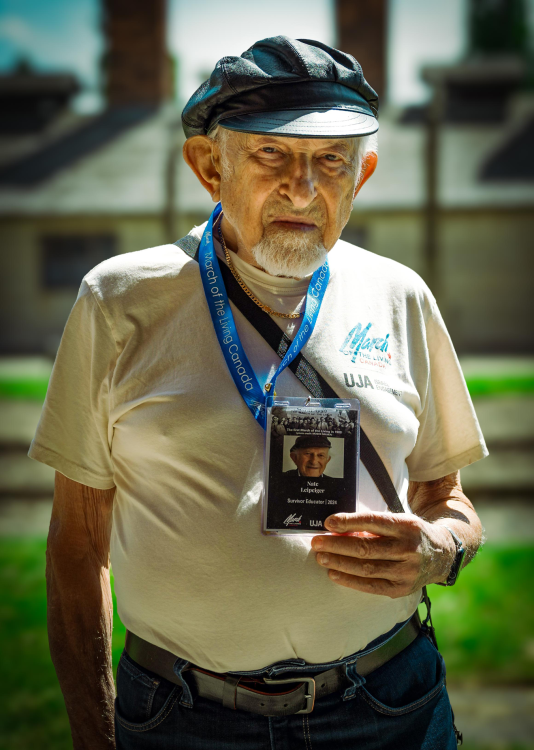
Nate has attended the March of the Living 20 times more than any other Holocaust survivor from the Diaspora.
On the trip, Nate advises young people not to hold hatred in their hearts.
“You cannot have hate in your heart without being hateful against yourself….when you are hateful, you become bitter, you resent everything, and that becomes part of your nature.”
Nate has participated in March 22 times as of 2026 and continues to educate people to ensure the message is passed down to new generations.
Documentary Films & Educational Work
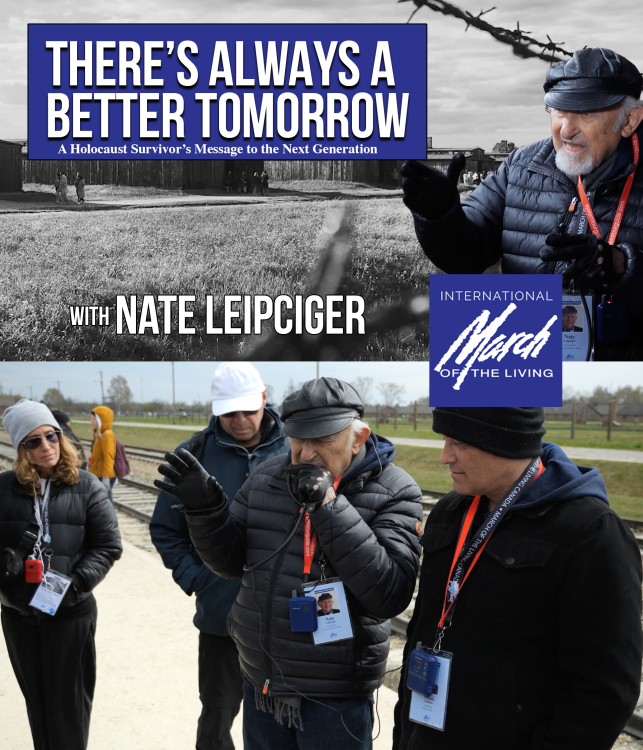
2026: There’s Always A Better Tomorrow
Click here to download the synopsis
Click here to view the trailer
First broadcast on JBS TV on Holocaust Survivor Day, June 4, 2026. Directed by Max Silverberg and produced by Eli Rubenstein.
Synopsis:
At 98, Holocaust survivor Nate Leipciger returns to Auschwitz-Birkenau with the March of the Living, reflecting on loss, resilience, and the responsibility of passing memory to future generations
In 2026, Nate embarked on this emotional trip for the 22nd time, more than any other Holocaust survivor educator who has accompanied young people to Poland on this life-changing experience.
Guiding participants through the very places where he endured unimaginable loss more than 80 years earlier, Nate recounts the separation from his mother and sister, the courage of his father that saved his life, and the memories that continue to live with him decades later.
Through intimate testimony filmed on location, the documentary captures both the horrors of the Holocaust and the emotional weight of returning to the place where his family was murdered. Surrounded by his daughters, son-in-law, and thousands of young participants in the March of the Living, Nate reflects on survival, grief, and the life he built in Canada after the war.
As one of the last remaining survivors of Auschwitz who is physically able to guide future generations through Auschwitz, Nate carries the responsibility of remembrance for those who could never tell their stories.
This film is a powerful meditation on memory, family, the survival of the Jewish people, and the enduring triumph of life over destruction.
A Speaker, an Educator
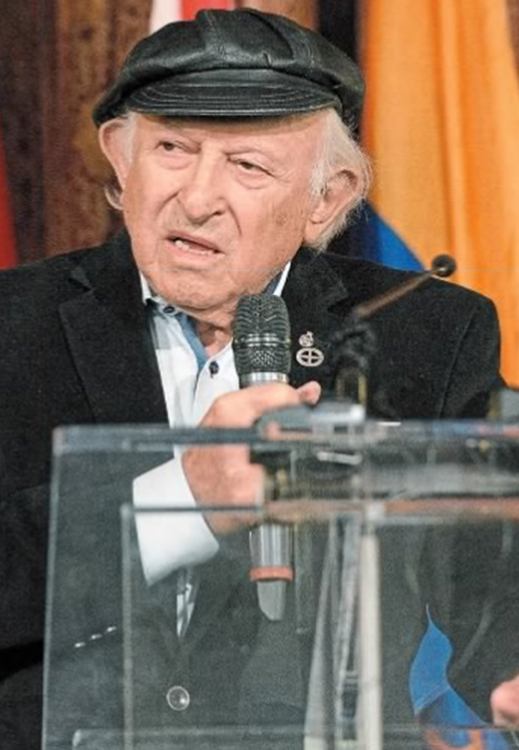
For more than three decades, Nate Leipciger has been an active speaker, educator, and advocate for Holocaust remembrance. Through the March of the Living, school programs, community events, museum initiatives, and public commemorations, he has shared his testimony with students, educators, civic leaders, and wider audiences in Canada and abroad. Leipciger has returned to Auschwitz-Birkenau many times as an educator, helping young people understand the Holocaust through both historical context and personal witness. His educational work has also included speaking through institutions such as the Toronto Holocaust Education and Memorial Centre, the Neuberger Holocaust Education Centre, the Azrieli Foundation, and international remembrance programs. In 2016, he accompanied Prime Minister Justin Trudeau through Auschwitz-Birkenau, where he described his own experiences in the camp and reflected on the murder of his mother and sister. In later years, Leipciger continued to speak publicly about survival, memory, antisemitism, and the responsibilities of future generations, including through his memoir The Weight of Freedom and numerous public testimony programs.
Photo Credit: Hamilton Spectator (2018). Nate Leipciger was the keynote speaker at the annual Prayer Breakfast
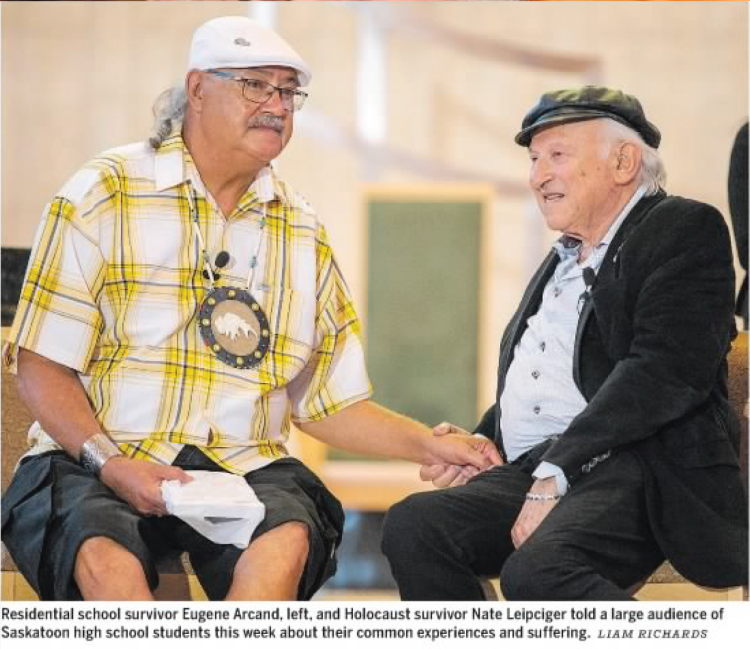
Leipciger has also taken part in educational events that connect Holocaust remembrance with other histories of persecution and dehumanization. In 2018, he spoke at a Saskatoon school alongside residential school survivor Eugene Arcand, where both men addressed students about their experiences of abuse, survival, and the long-term effects of trauma. The event highlighted Leipciger’s broader approach to public education, using personal testimony not only to preserve Holocaust memory but also to encourage empathy, dialogue, and recognition of shared human dignity across different communities.
Click to read The article in the Leader Post
By connecting his experience as a Holocaust survivor with the experiences of Indigenous survivors in Canada, he helped frame remembrance as a shared responsibility: to listen, to recognize the humanity of others, and to resist hatred, indifference, and the conditions that allow people to be stripped of dignity.
Photo: The Leader Post – Saskatoon (2018)