
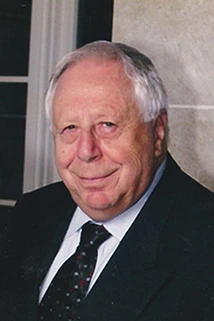
Holocaust Survivor, Author, Educator, and March of the Living Witness
Abram “Amek” Adler z”l was born in Lublin, Poland, on April 20, 1928, and grew up in Łódź. Like many children his age, Amek expected life to continue in familiar ways. In August 1939, at just 11 years old, he was preparing to return to school after summer break. But on September 1, 1939, Germany invaded Poland, and his childhood was violently interrupted. School, friends, and the ordinary routines of youth were replaced by fear, persecution, forced labour, hunger, and the separation of families.
Following the outbreak of the war, Amek and his family fled first to Warsaw and then to Radom. In 1943, he was deported to Auschwitz-Birkenau. Over the next few years, he was imprisoned in several Nazi camps and forced labour sites before eventually being sent to Dachau. During the Holocaust, Amek’s father and one of his brothers were murdered. He survived six lost years of childhood under Nazi persecution and was liberated on April 28, 1945.
After liberation, Amek was eventually reunited with his mother and two of his brothers. From 1945 to 1947, he lived in Italy, where he worked with the Irgun Tzvai Leumi to assist Jewish refugees trying to reach Palestine. In 1948, he immigrated to Sweden, and in 1954, he came to Toronto, Canada, with his wife, Ruth.
In Canada, Amek rebuilt his life with determination and dignity. He became successful in both the fur and jewellery industries and later served as president of the Canadian Jewellers Association in 1989. He and Ruth built a family together and were blessed with two children and four grandchildren.
In his later years, Amek became one of the many Holocaust survivors who devoted themselves to education, sharing testimony in schools and communities across Canada. Through his words, students and audiences heard not only about the suffering he endured but also about the strength required to survive, rebuild, and bear witness. His autobiography, Six Lost Years, was published in early 2017, preserving his memories for future generations.
Amek passed away on April 25, 2017, while in Regina, Saskatchewan, where he had travelled to share his story. His life remains a powerful reminder of the childhood stolen from Jewish children during the Holocaust, the resilience of survivors, and the responsibility to preserve their memories with care and respect.

Videos/Media ON the MOL Digital Archive Project:
Amek Adler: Welcome to Auschwitz
Amek Adler – It’s Our Duty to Come Here (Treblinka) 2008 ⧉
Amek Adler – Shema Yisrael Story 2006 ⧉
Stories: Escape from Lodz to Warsaw
In December 1939, as conditions for Jews in Łódź became increasingly dangerous under German occupation, & Adler’s father made the decision that the family had to leave. Together with two other families, they arranged to escape to Warsaw, the only destination they believed might still offer a chance of survival. They hired a driver whom Adler described as a Pole of German descent, a man who owned a large canvas-covered truck. To hide the families, furniture was loaded toward the front of the truck while the families sat concealed in the back.
What should have been a journey of only four or five hours lasted through the night. Along the way, the truck was stopped several times at wartime checkpoints. Soldiers opened the back curtains, and each time the families feared they would be discovered. In testimony, Adler later described these moments as miracles. Because the driver spoke German, the soldiers focused on the heavy furniture and allowed the truck to continue. Looking back, Adler understood how close they had come to death, believing that if the soldiers had noticed the hidden families, they likely would not have survived the journey.
Working in Radom, PL
You had to grow up in a hurry…”
Amek described part of the burden of surviving as a child under Nazi rule. “You had to grow up in a hurry,” he remembered. Amek Adler and his family relocated to Radom, a city in east-central Poland, located approximately 100 km south of Warsaw. While there was very little work, his brother, Ben, found work in a downtown office building occupied by the SD, the German Security Service. Ben became the superintendent of the building, and when the work became too much for one person, he was allowed to bring in help. Amek, then about 13 and a half years old, became his assistant.
Amek’s duties were ordinary on the surface: changing light bulbs, cleaning stairs and hallways, and helping maintain the building. But the building itself exposed him to the brutal reality of the occupation. In the lower rooms, Polish professionals (including lawyers, doctors, teachers, and priests) were being interrogated because the Germans feared educated community leaders might help organize resistance. Amek shared about the trauma of hearing the terrible sounds that came from those rooms, and how they were still with him in life.
Amek was also made to serve a German officer, a Hauptmann, or captain. He cleaned the officer’s boots, pressed his uniform, and performed other tasks. At times, if the officer was in a generous mood, Amek was given a piece of bread or salami to bring home to his family. These small scraps of food mattered deeply in a time of hunger and fear.
March of the Living Canada – Amek Adler Testimony
1. Amek Adler – Life before the War
2. Moving to Lodz; Jewish Life in Lodz
3. Leaving Lodz
4. Moving to Warsaw; The Story about the Hat
5. The Incident with a Hitlerjugend
6. Leaving Warsaw
7. The Radom Ghetto; The Crematoria
8. Amek’s Work Camp
9. The Missing Man
10. The Traumatic Shooting
11. The Walk from Auschwitz to Radom
12. Slave Labour in Stuttgart, Germany
13. Natzweiler Camp
14. Arrival in Dachau.
15. A Prisoner in Dachau; Disease
16. Escape from the Death March in Austria
17. Liberation by the American Army
18. Reunion with Ben Adler
19. Reunion with his Older Brother
20. Dachau and Majdanek; His Mother and General Eisenhower
21. Visiting his Brother in Ancona, Italy
22. Joining a Kibbutz and Obtaining a Passport
23. Postwar Life – Sweden
24. The Irgun
25. The Irgun, Part 2
26. On the Train from Rome to Calabria
27. Sweden to Canada
28. 1950s Toronto
29. Revisiting the Past