
Holocaust Survivor, Hidden Child, Artist, Educator, and March of the Living Witness
Gabriella Karin was born Gabriella Foldes on November 17, 1930, in Bratislava, Czechoslovakia, to Arpad and Sari Foldes. Her family owned a delicatessen near the local police station, a location that later became part of the family’s wartime story as her mother, Sari, worked with the Slovak underground and helped warn Jewish families targeted for deportation.
As persecution against Jews in Slovakia increased, Gabriella’s childhood was disrupted. In 1941, after she could no longer attend school as a Jewish child, her parents obtained false papers for her and sent her to the Ursuline convent school in Bratislava, where she lived under an assumed Christian identity. She was separated from her parents during the school year and later remembered the fear and loneliness of that period.
In March 1942, mass deportations of Jews from Slovakia began. Sari Foldes, working with the underground, received information about families scheduled for deportation and went out to warn them. Gabriella sometimes accompanied her mother on these dangerous visits, witnessing the fear of families who knew they might soon be taken away.
By August 1944, Gabriella and her family were forced into hiding. She was fourteen years old. Together with seven others, she hid in a small apartment in Bratislava belonging to Karol Blanar, a young lawyer who risked his life to protect them. The apartment was located across the street from the Nazi-Slovak Gestapo, making the hiding place both terrifying and strangely protected, because the building’s rules officially barred Jews from living there and the authorities did not search it.
For nine months, Gabriella lived in hiding, unable to move freely or speak openly. She spent long hours reading, while outside the window she could sometimes see people being arrested and taken away. In the final weeks of the war, heavy bombing forced the group into a shelter before Soviet troops entered Bratislava in April 1945.
Life after the Holocaust
After liberation, Gabriella returned to school and completed a diploma in fashion design and business. In 1948, she married Frantisek Lederer, who later changed his name to Ofer Karin. The couple moved to Israel in 1949, where they began rebuilding their lives. Their son, Rom, was born in 1958, and in 1960 the family immigrated to Los Angeles.
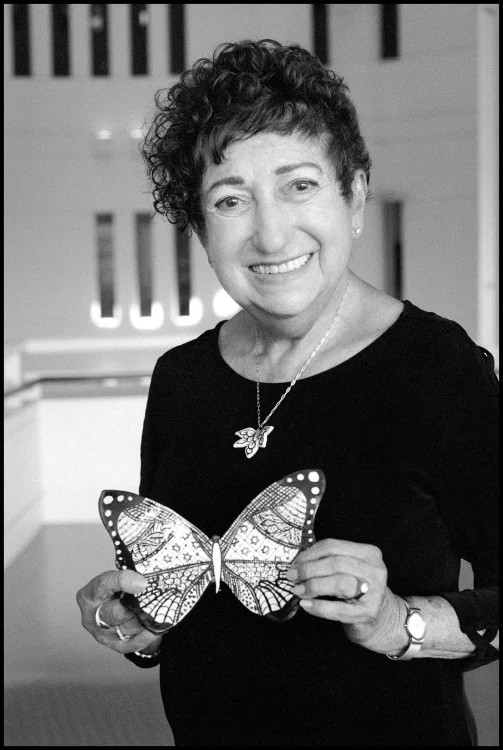
In Los Angeles, Gabriella worked as a fashion designer until retiring in 1992. Soon afterward, she turned to sculpture, creating works that drew on her memories of the Holocaust, the loss of family members, the experience of hiding, and the hope that future generations would reject hatred and prejudice. Her Holocaust sculptures include works dedicated to hidden children, rescuers, family members who perished, and the emotional memory of the six million Jews murdered during the Holocaust.
Gabriella also spent years searching for Karol Blanar, the man who saved her family. She later learned that he had escaped communist Slovakia, immigrated to the United States, and died in Ohio in 1980. Gabriella posthumously nominated him for recognition by Yad Vashem as Righteous Among the Nations, and the nomination was accepted in 2006. She also arranged for a headstone to be placed at his grave in Columbus, Ohio.
Passing the Torch
Gabriella Karin has dedicated much of her later life to Holocaust education. She has spoken at Holocaust Museum Los Angeles, the Museum of Tolerance, schools, universities, and community programs, using both her testimony and her art to help students understand the human reality of the Holocaust. Holocaust Museum LA describes her as an acclaimed sculptor whose work depicts the horrors of the Holocaust while also inspiring hope for a more peaceful future.
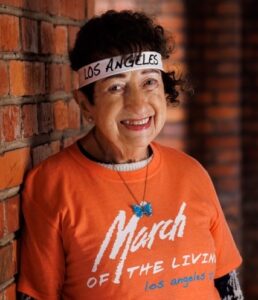
She has also been connected with March of the Living, travelling with students to Poland and Israel and sharing her experiences as a survivor and educator. Gabriella’s own website notes her participation with March of the Living, where survivors become guides, storytellers, and living witnesses for young people confronting Holocaust history.
Through MOLDAP and the USC Shoah Foundation partnership, Gabriella Karin’s testimony has been preserved in 360° on-location video and in a Virtual IWALK module. These digital resources allow students and educators to encounter her testimony in connection with sites in Bratislava and other places tied to her wartime experience.
360-Degree on-location Testimony Featured on MOLDAP

Gabriella Karin 05 1 BRATISLAVA CUKROVA INTERVIEWER MONO
Gabriella Karin 05 2 BRATISLAVA CUKROVA MONO
Gabriella Karin 05 3 BRATISLAVA CUKROVA SLOVAK MONO
Gabriella Karin 05 4 BRATISLAVA CONVENT HALLWAY MONO
Gabriella Karin 05 5 BRATISLAVA CONVENT HALLWAY SLOVAK MONO
Gabriella Karin 05 6 BRATISLAVA CONVENT HALLWAY MONO
Gabriella Karin 05 9 BRATISLAVA SYNAGOGUE MONO
Gabriella Karin 05 10 BRATISLAVA SYNAGOGUE SLOVAK MONO
Gabriella Karin 05 11 BRATISLAVA SYNAGOGUE MUSEUM MONO
Gabriella Karin 05 12 BRATISLAVA SYNAGOGUE MUSEUM SLOVAK MONO
Gabriella Karin 05 13 BRATISLAVA SYNAGOGUE EXTERNAL MONO
Gabriella Karin 05 14 BRATISLAVA SYNAGOGUE EXTERNAL SLOVAK MONO
Gabriella Karin 05 15 MALZENICE CEMETERY INTERVIEWER MONO
Gabriella Karin 05 16 BRATISLAVA CONVENT EXTERNAL INTERVIEWER MONO
Gabriella Karin 05 17 BRATISLAVA CONVENT EXTERNAL MONO
Gabriella Karin 05 18 BRATISLAVA CONVENT EXTERNAL SLOVAK MONO
Gabriella Karin 05 19 BRATISLAVA MAYOR OFFICE MONO
Gabriella Karin 05 24 BRATISLAVA DUNAJSKA HIDING MONO
Gabriella Karin 05 25 BRATISLAVA DUNAJSKA SLOVAK HIDING MONO
Gabriella Karin 05 26 BRATISLAVA DUNAJSKA FRIENDS MONO
Gabriella Karin 05 27 BRATISLAVA DUNAJSKA SLOVAK FRIENDS MONO

Gabriella Karin — Virtual IWALK on IWitness
In this Virtual IWalk, created by USC Shosh Foundation and developed in cooperation with March of the Living, we will follow Gabriella Karin, a child survivor from Bratislava, Slovakia, to the sites of her prewar and wartime experiences.
The interviews featured in this Virtual IWalk were recorded using 360-degree technology that captured Gabriella and her surroundings, allowing students to virtually explore the environment as it appears today.
launch IWALK On IWitness
*Users need to register to start the IWalk