

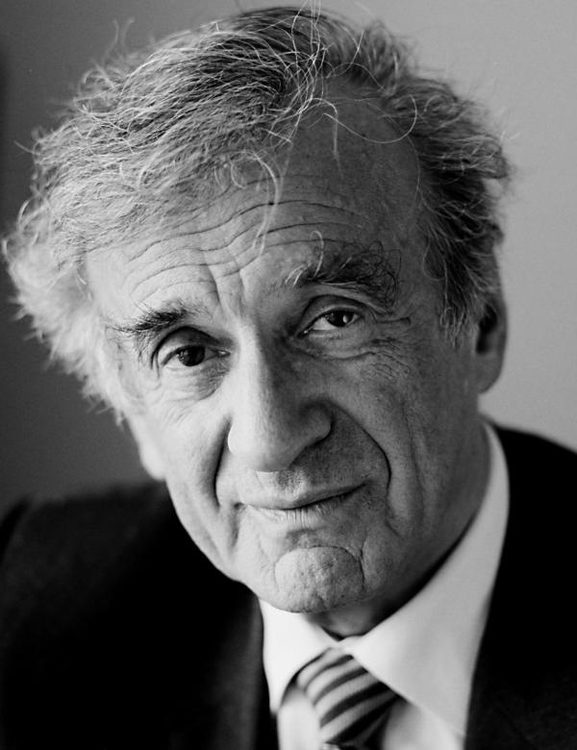
Holocaust Survivor, Nobel Laureate, Author, Human Rights Advocate, and March of the Living Witness
Elie Wiesel z”l was born on September 30, 1928, in Sighet, Transylvania, then part of Romania and, from 1940 to 1945, under Hungarian rule. He grew up in a religious Jewish family with his parents, Shlomo and Sarah, and his sisters Hilda, Beatrice, and Tzipora. As a child, he studied Jewish texts, was drawn to Hasidic stories and mysticism, and lived in a Jewish community that would soon be destroyed by the Holocaust.
In 1944, after Nazi Germany occupied Hungary, the Jews of Sighet were forced into ghettos and then deported. Elie Wiesel was fifteen years old when he and his family were deported to Auschwitz-Birkenau in May 1944. His mother, Sarah, and younger sister, Tzipora, were murdered. Elie, his father Shlomo, and his two older sisters were selected for forced labour.
Elie and his father were later sent to Auschwitz III, also known as Monowitz or Buna, where they endured slave labour, starvation, brutality, and the daily struggle to survive. In January 1945, as the Soviet army approached Auschwitz, Elie and his father were forced on a death march and then transported to Buchenwald. Shlomo Wiesel died there shortly before liberation. Elie Wiesel was liberated at Buchenwald by American forces on April 11, 1945.
After the war, Elie was sent to children’s homes in France. He was eventually reunited with his older sisters Hilda and Beatrice, who had also survived. His parents and younger sister Tzipora had been murdered.
For almost a decade after the Holocaust, Wiesel remained largely silent about what he had endured. A meeting with the French Catholic writer François Mauriac helped persuade him to write about his experiences. His memoir La Nuit, later known in English as Night, was published in 1958 and became one of the most important works of Holocaust literature. In Night, Wiesel bore witness to the destruction of his family, the camps, the death march, the loss of humanity, and his own spiritual struggle
A Major Voice of the Holocaust
Elie Wiesel became a journalist, author, professor, and one of the world’s most recognized moral voices. He wrote more than forty books and taught at several universities, including the City University of New York and Boston University, where he became the Andrew W. Mellon Professor in the Humanities in 1976.
Wiesel’s work extended far beyond Holocaust memory. He spoke out for Soviet Jews, Cambodian refugees, victims of apartheid in South Africa, victims of famine in Africa, the Kurds, the disappeared in Argentina, and victims of war and ethnic cleansing in the former Yugoslavia. His public life joined memory with responsibility, insisting that the suffering of the Jewish people required a broader commitment to human dignity.
“The opposite of love is not hate, it’s indifference. The opposite of art is not ugliness, it’s indifference. The opposite of faith is not heresy, it’s indifference. And the opposite of life is not death, it’s indifference.”
In 1978, President Jimmy Carter appointed Elie Wiesel chairman of the President’s Commission on the Holocaust. In 1980, Wiesel became the founding chairman of the United States Holocaust Memorial Council, helping shape the vision for the United States Holocaust Memorial Museum as a living memorial that would inspire future generations to confront hatred, prevent genocide, and promote human dignity.
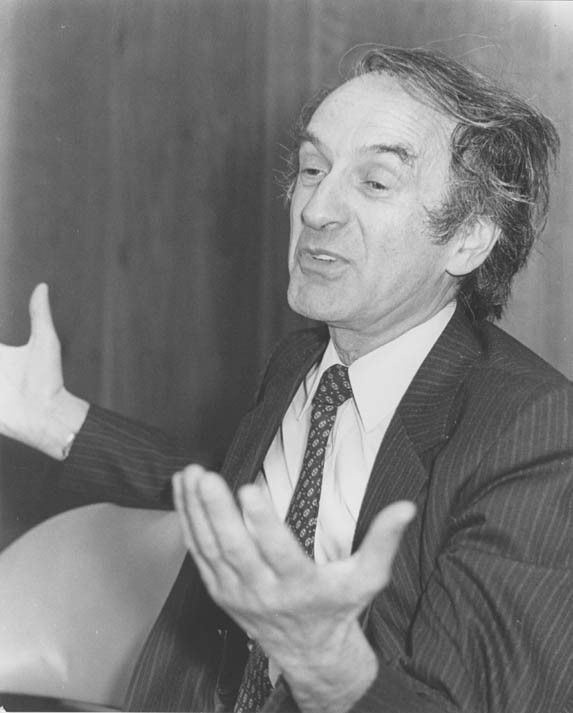
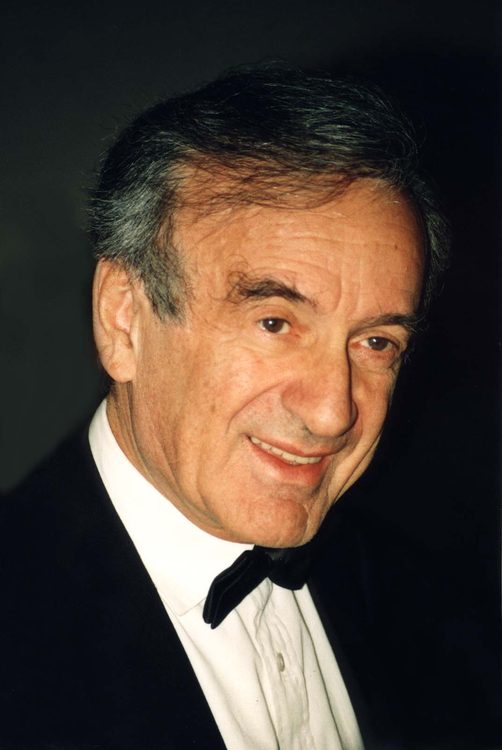
In 1986, Elie Wiesel was awarded the Nobel Peace Prize. The Nobel Committee described him as a “messenger to mankind,” whose message was one of peace, atonement, and human dignity. Three months after receiving the prize, Elie and Marion Wiesel established the Elie Wiesel Foundation for Humanity to advance human rights and ethical dialogue.
“We must always take sides. Neutrality helps the oppressor, never the victim. Silence encourages the tormentor, never the tormented.”
Elie Wiesel served on the Presidium for the first March of the Living in 1988 and attended the March in 1990. In 2005, during the 60th anniversary of the end of the Second World War, he addressed more than 18,000 participants, one of the largest gatherings in the program’s history.
One of the most remembered March of the Living moments connected to Wiesel took place at Auschwitz-Birkenau in 1990. Speaking before students and survivors, he began to describe a young girl he remembered from Auschwitz, but the memory became too painful, and words failed him. Eli Rubenstein later wrote that Wiesel’s silence that day became a form of testimony, showing that even the most eloquent witness to the Holocaust could reach a place where language could no longer carry the weight of memory. (Article: The Day Words Failed Elie Wiesel)
Elie Wiesel passed away in New York City on July 2, 2016, at the age of 87. His legacy continues through Night, his many books, the Elie Wiesel Foundation, the United States Holocaust Memorial Museum, the Nobel Peace Prize, March of the Living, and the generations of students, educators, and readers who continue to encounter his voice.
“I believe firmly and profoundly that whoever listens to a witness becomes a witness, so those who hear us, those who read us must continue to bear witness for us.” – Elie Wiesel, during his address at the Legacy of Holocaust Survivors Conference held at Yad Vashem in 2002
Through MOLDAP and March of the Living, Elie Wiesel’s connection to Holocaust memory, testimony, and student education remains part of the larger mission to preserve survivor voices and pass them to future generations.
Featured MOLDAP Media
The Day Words Failed Elie Wiesel— Auschwitz-Birkenau, 1990 March of the Living Speech, 1990
A MOLDAP / March of the Living address at Auschwitz-Birkenau in which Elie Wiesel speaks to students and survivors during Yom HaShoah. This clip shows the moment Wiesel could not continue speaking while remembering a young girl he had seen during the Holocaust
Elie Wiesel — Conscience of the World
A MOLDAP-listed documentary film about Elie Wiesel’s life, moral voice, and legacy.
Link: https://www.youtube.com/watch?v=1L8FBIwB-S0
Elie Wiesel — Nobel Peace Prize Acceptance Speech
Nobel Prize page for Wiesel’s 1986 acceptance speech in Oslo.
Elie Wiesel’s Remarks at the Dedication of the United States Holocaust Memorial Museum, April 22, 1993
USHMM text of Wiesel’s dedication remarks, including his famous statement: “For the dead and the living, we must bear witness.”
https://www.ushmm.org/information/about-the-museum/mission-and-history/wiesel