
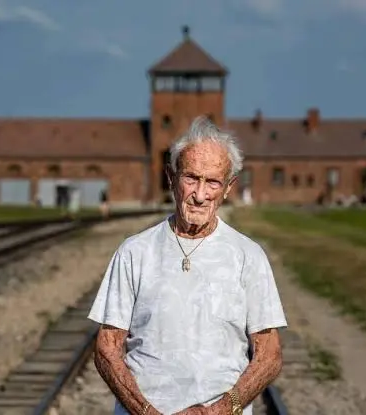
Holocaust Survivor, Educator, Philanthropist, and March of the Living Witness
Edward “Ed” Mosberg z”l was born on January 6, 1926, in Kraków, Poland. He grew up in a Jewish family with his parents and two sisters in a city that was home to a large and vibrant Jewish community before the Second World War. He was thirteen years old when Nazi Germany invaded Poland in September 1939, destroying the world of his childhood.
After the German occupation of Kraków, Mosberg and his family were forced into the Kraków Ghetto. The family was crowded into a single apartment with relatives, while deportations, violence, and terror increasingly consumed Jewish life in the city. In 1943, during the liquidation of the ghetto, Mosberg and surviving members of his family were sent to the Płaszów forced labour and concentration camp.
At Płaszów, Mosberg was imprisoned under the command of Amon Göth, the camp commandant later tried and executed for war crimes. Mosberg’s mother and sisters were deported from Płaszów to Auschwitz, where they were murdered. Mosberg himself was later sent first to Auschwitz and then to Mauthausen in Austria, where he endured brutal forced labour and the camp’s infamous quarry and “Stairs of Death.”
In 1944, Mosberg was transferred to a slave labour camp in Linz, Austria, connected to the Hermann-Göring factory system. He survived the final months of the war under extreme conditions and was liberated by American forces in 1945. The Mauthausen camp system and its Linz subcamps were liberated by U.S. troops in early May 1945.
After liberation, Mosberg was sent to Italy to recover from tuberculosis. While there, he reconnected with Cesia “Cecile” Storch, a fellow survivor from Kraków who had also endured Nazi camps and had known his sisters. Edward and Cecile later married, first in Kraków and then in Belgium, before immigrating to the United States in 1951 with their first child. They eventually settled in New Jersey and built a new life and family together.
For many years, Edward and Cecile did not speak publicly about their Holocaust experiences. Later in life, especially after the release of Schindler’s List, Edward began sharing his testimony widely.
He spoke in schools, synagogues, community centres, and public programs, carrying what he understood as a duty to speak for his murdered family and for the six million Jews murdered in the Holocaust.
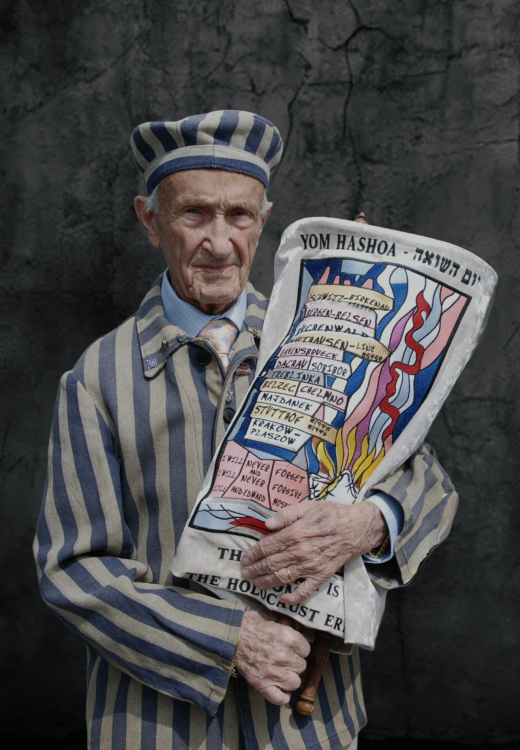
Mosberg became one of the most recognizable survivor witnesses connected with March of the Living. He returned many times to Poland and Auschwitz-Birkenau with students and educators, often wearing a striped prisoner uniform and carrying symbols of memory. His final trip to Poland with March of the Living took place only a few months before his death.
He was also closely connected with USC Shoah Foundation. Mosberg recorded Visual History Archive testimony in 2016, participated in USC Shoah Foundation’s Dimensions in Testimony interactive biography project in 2018, and was filmed in 360° testimony on location with March of the Living and USC Shoah Foundation at sites including Mauthausen, Kraków, Płaszów, Auschwitz-Birkenau, and Ebensee.
Mosberg appeared in the documentary film Destination Unknown and was also the subject of a portrait by artist David Kassan for the Facing Survival exhibition, co-curated by USC Shoah Foundation and USC’s Fisher Museum of Art. His testimony and public presence became part of a larger mission to ensure that Holocaust memory remained personal, urgent, and impossible to ignore.
In 2019, President Andrzej Duda of Poland awarded Mosberg the Commander’s Cross of the Order of Merit of the Republic of Poland for his work in developing Polish-Jewish dialogue and promoting knowledge about the role of Poles who rescued Jews during the Holocaust. After Mosberg’s death, President Duda also announced that he would receive the Grand Cross of the Order of Merit of the Republic of Poland.
Edward Mosberg passed away on September 21, 2022. His legacy continues through his family, his testimony, March of the Living, USC Shoah Foundation, Dimensions in Testimony, and the many students and educators who encountered his story. Through MOLDAP, his testimony remains part of a larger effort to preserve survivor memory through digital, on-location, and interactive educational resources
Ed Mosberg Videos & Media
Edward Mosberg on Being Separated from His Sisters — USC Shoah Foundation
In this video, he explains how he was separated from his sisters at Płaszów and the guilt he carried afterward.
Edward Mosberg on Why He Tells His Story — USC Shoah Foundation
MOLDAP MOLDAP Dimensions in Testimony page:
https://molarchiveproject.com/dit/
Featured MOLDAP 360-degree Media

01 1 MAUTHAUSEN QUARRY INTERVIEWER MONO
01 2 MAUTHAUSEN GATE INTERVIEWER MONO
01 3 MAUTHAUSEN APPELLPLATZ INTERVIEWER MONO
01 4 MAUTHAUSEN WAILING WALL INTERVIEWER MONO
01 5 MAUTHAUSEN SHOWERS INTERVIEWER MONO
01 6 MAUTHAUSEN QUARANTINE BARRACKS INTERVIEWER MONO
01 7 MAUTHAUSEN INSIDE BARRACK INTERVIEWER MONO
01 8 MAUTHAUSEN STAIRS INTERVIEWER MONO
01-10 KRAKOW GHETTO FIRST HOME
01-13 KRAKOW GHETTO THIRD HOME
Ed Mosberg 00 2 MAUTHAUSEN APPELLPLATZ BROLL MONO
Ed Mosberg 00 3 MAUTHAUSEN APPELLPLATZ MIDDLE BROLL MONO
Ed Mosberg 00 4 MAUTHAUSEN BARRACKS MEADOW BROLL MONO
Ed Mosberg 00 17 EBENSEE GATE BROLL MONO
Ed Mosberg 00 19 EBENSEE MEMORIAL 2 BROLL MONO
Ed Mosberg 00 20 EBENSEE MEMORIAL 3 BROLL MONO
Ed Mosberg 01 1 MAUTHAUSEN QUARRY INTERVIEWER MONO 2025
Ed Mosberg 01 2 MAUTHAUSEN GATE INTERVIEWER MONO 100 2025
Ed Mosberg 01 3 MAUTHAUSEN APPELLPLATZ INTERVIEWER MONO 2025
Ed Mosberg 01 4 MAUTHAUSEN WAILING WALL INTERVIEWER MONO 2025
Ed Mosberg 01 5 MAUTHAUSEN SHOWERS INTERVIEWER MONO 2025
Ed Mosberg 01 6 MAUTHAUSEN QUARANTINE BARRACKS INTERVIEWER MONO 2025


Ed Mosberg 01 7 MAUTHAUSEN INSIDE BARRACK INTERVIEWER MONO 2025
Ed Mosberg 01 8 MAUTHAUSEN STAIRS INTERVIEWER MONO 2025
Ed Mosberg 01 9 KRAKOW GHETTO GATE MONO 2025
Ed Mosberg 01 10 KRAKOW GHETTO FIRST HOME MONO 2025
Ed Mosberg 01 11 KRAKOW GHETTO WALL MONO 2025
Ed Mosberg 01 12 KRAKOW GHETTO MEMORIAL MONO 2025
Ed Mosberg 01 13 KRAKOW GHETTO THIRD HOME MONO 2025
Ed Mosberg 01 14 PLASZOW GREY VILLA MONO 2025
Ed Mosberg 01 15 PLASZOW APPELLPLATZ INTERVIEWER MONO 2025
Ed Mosberg 01 16 PLASZOW JEWISH MEMORIAL MONO 2025
Ed Mosberg 01 17 PLASZOW CREMATORIUM MONO 2025
Ed Mosberg 01 18 BIRKENAU RAMPE INTERVIEWER MONO 2025
Ed Mosberg 01 19 BIRKENAU ROAD MONO 2025
Ed Mosberg 01 20 BIRKENAU POND MONO 2025
Ed Mosberg 01 21 BIRKENAU FOREST MONO 2025
Ed Mosberg 01 22 BIRKENAU CREMATORIUM V MONO 2025